Capability 01
Know where AI actually pays before you buy anything.
Where AI pays in your business, where it doesn't yet, and what has to be true before it does. Sequenced into decisions, not a platform's release calendar.
Best fit: before you buy anything
Downloads
take it to the meeting- Service sheetPDF · 1 page
- AI Opportunity Map — engagement briefPDF · 8 pages
- All six service sheetsPDF · 6 pages
Service sheets follow one standard across all six capabilities. Engagement status on each sheet is taken from the live catalogue.
The problem
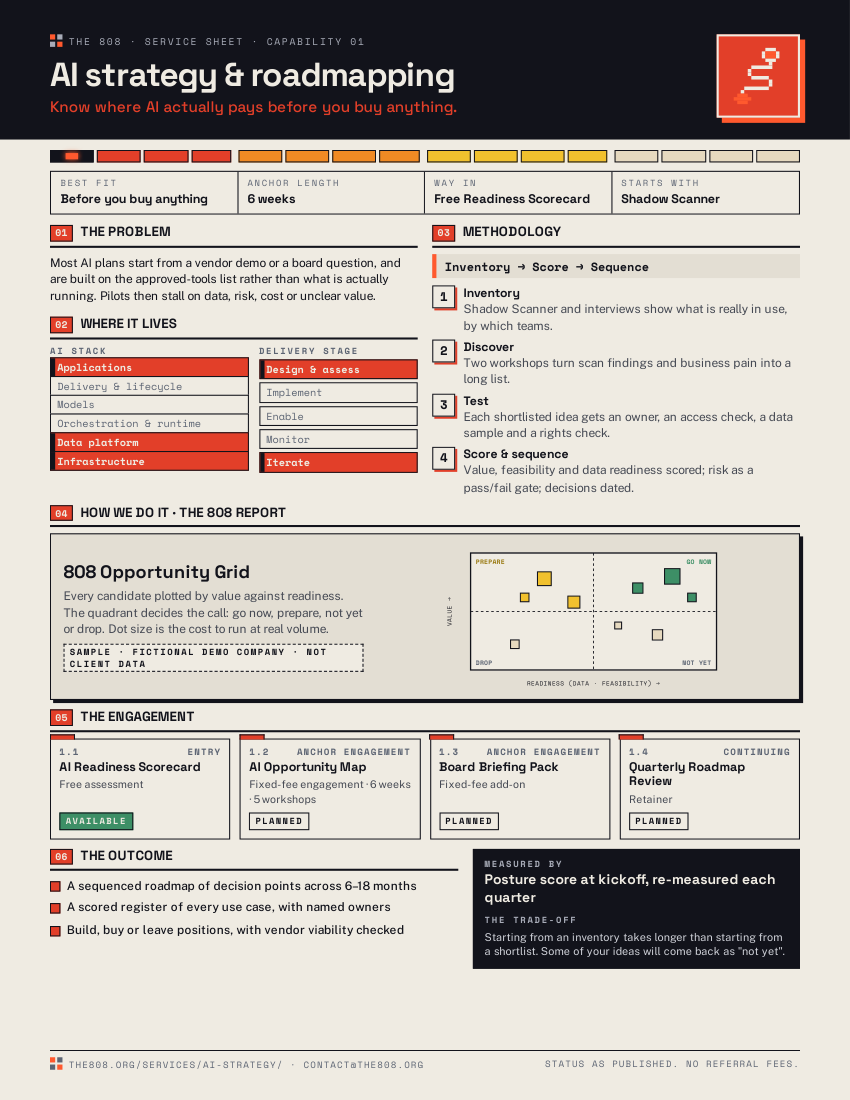
what goes wrongMost AI strategies start from the wrong end: a vendor demo, a board question, a competitor's press release. The roadmap ends up shaped by someone else's calendar. The pilots never had a route to production.
The second mistake is starting from the intended stack. Every organisation can describe the one it approved. Far fewer can describe the one that exists. A plan built on the licence list inherits every gap in it.
The hard part is deciding what not to do. Which processes have the volume, the clean data and a named owner to justify the spend? Which don't, yet? Both answers belong in the plan.
What we do
four piecesCurrent-state assessment
Where data, identity and infrastructure actually stand, taken from telemetry. Including the constraints nobody wrote down.
Opportunity mapping
Use cases scored on value, feasibility and data readiness. Each has a named owner. None is scored on how well it demos.
Sequenced roadmap
Decision points across 6–18 months, each with the conditions that must hold before it unlocks.
Build-vs-buy position
What to build, what to buy, and what to leave alone for now — written down with the reasoning, so it can be revisited rather than re-argued.
Tools & resources
how this service uses themDownloads for this service are above. All free tools run in your browser and need no email.
What good looks like
6 of 6 coveredWhat buyers are increasingly measured against here, taken from the frameworks doing the measuring. Each line names the engagement that covers it. Where nothing does yet, the row says so.
| Capability | What done properly looks like | Covered by |
|---|---|---|
| A current-state inventory before any roadmapNIST AI RMF · Map | Applications, models and owners are documented from telemetry, not from a survey that people fill in from memory. | 1.2 AI Opportunity Map |
| Use cases scored on value and feasibility togetherPortfolio practice | Every candidate carries a value estimate, a data-readiness score and a named owner before it enters the plan. | 1.2 AI Opportunity Map |
| Explicit build-versus-buy positionsProcurement practice | The decision is written down with its reasoning, so it can be revisited when the market moves rather than re-argued. | 1.2 AI Opportunity Map |
| A measurable baseline you can re-measureNIST AI RMF · Measure | A posture score taken at the start, repeated on a fixed cadence, so progress is evidenced rather than asserted. | 1.1 AI Readiness Scorecard |
| Board-level reporting in business termsISO/IEC 42001 · Leadership | Spend, exposure and sequencing framed so a non-technical director can interrogate them. | 1.3 Board Briefing Pack |
| A review cadence tied to the budget cycleISO/IEC 42001 · Improvement | The roadmap is revisited quarterly against what actually shipped and what changed in the market. | 1.4 Quarterly Roadmap Review |
Sample report: 808 Opportunity Grid
808 demo datasetFictional demo company · sample data, not a client
Lakeshore Example Co.
A fictional 1,200-person distributor we use to show what our reports look like. Every number below is invented for the demo.
- 34 candidate use cases collected in two workshops
- 9 shortlisted and plotted: 3 go now, 3 prepare, 2 not yet, 1 drop
- Posture score 52 / 100 at kickoff
- First decision point: support-ticket summarisation, target Q3
Engagements & products
status shownThe deliverables behind this capability. We publish what is live and what is still being built rather than implying a bench we don't have.
-
1.1 Entry Available
AI Readiness Scorecard
Free assessment
A short self-assessment across data readiness, identity, governance and skills. You get a banded score and the two or three constraints most likely to stall a first deployment — before anyone writes a business case.
Shadow Scanner The scorecard is self-reported. A scan is the verified version of the same picture, which is usually a sharper conversation.
-
1.2 Anchor engagement Planned
AI Opportunity Map
Fixed-fee engagement · 6 weeks · 5 workshops
We assess where you actually are and score candidate use cases on value, feasibility and data readiness. You get a sequenced roadmap of decision points across 6–18 months. Each one lists the conditions that must hold before it unlocks.
Full breakdown, downloads & tools →
Shadow Scanner The scan is step one, so the roadmap starts from your live footprint rather than the licence list.
-
1.3 Anchor engagement Planned
Board Briefing Pack
Fixed-fee add-on
The roadmap translated for the people who have to approve it. A short deck and a one-page summary framing spend, exposure and sequencing in business terms rather than technical ones.
Shadow Scanner Posture grade and exposure counts give the board a number to track, not an assurance to take on trust.
-
1.4 Continuing Planned
Quarterly Roadmap Review
Retainer
A standing quarterly session: what shipped, what moved in the market, and what the roadmap should now say. Keeps a plan from quietly going stale between budget cycles.
Shadow Scanner A re-scan each quarter shows whether the posture actually moved, which is the cleanest evidence a programme is working.
Status is kept in one place and shown as it stands. See the full catalogue across all six capabilities.
Further reading
frameworks · research · our work, on this topic- BriefAI Opportunity Map: how the engagement runs, week by weekOur method in full: inventory, scoring, the risk gate and the 18-month sequence.The 808 →
- ResearchThe State of AI (latest edition)Annual survey of how companies adopt AI and where they report value.McKinsey & Company ↗
- ReportAre You Generating Value from AI? The Widening GapWhy a small group of companies get most of the value from AI.Boston Consulting Group ↗
- FrameworkPlan for AI adoption: prioritise use cases and build a roadmapA vendor framework for ranking use cases. Useful to compare with ours.Microsoft (Cloud Adoption Framework) ↗
How Shadow Scanner helps
platform intelligence & risk telemetryStrategy starts with an inventory, and most organisations don't have an accurate one. Shadow Scanner runs a zero-knowledge assessment and returns what is actually in use: distinct applications, which AI models are called, and by which teams. That lands before the first roadmap decision, not after.
What you walk away with
the outcomeA roadmap your team can act on and your board can follow, with the reasoning attached. When the market moves, you can see which decisions still hold and which need revisiting.
The trade-off. Starting from an inventory takes longer than starting from a vendor shortlist. It also means some of the use cases you came in with will be marked "not yet".
Tell us what you're running.
A person replies within one business day.