Services · 6 capabilities
Six services. One way of running them.
Each service runs through the same five stages, so the work doesn't stop the day the tool goes live. Below the list is the full catalogue, with what is live and what is still being built.
The services
6 sub-sites · sheets, news, samplesWe don't resell software and we take no referral fees from AI, SaaS or security vendors. Our job is to tell you which tool fits the problem — sometimes none — and then help you run it safely.
Assessment comes before architecture. Most organisations can describe the stack they intended. Far fewer can describe the one that exists. So most engagements start with Shadow Scanner, which inventories the AI and SaaS actually in use and who is using it. To start on your own, the AI Readiness Scorecard is free, takes eight minutes and needs no email. When you have a list of ideas, the AI Roadmap Builder scores them with our method and sequences them into an 18-month roadmap. The enterprise AI stack sets out what we look for at each layer.
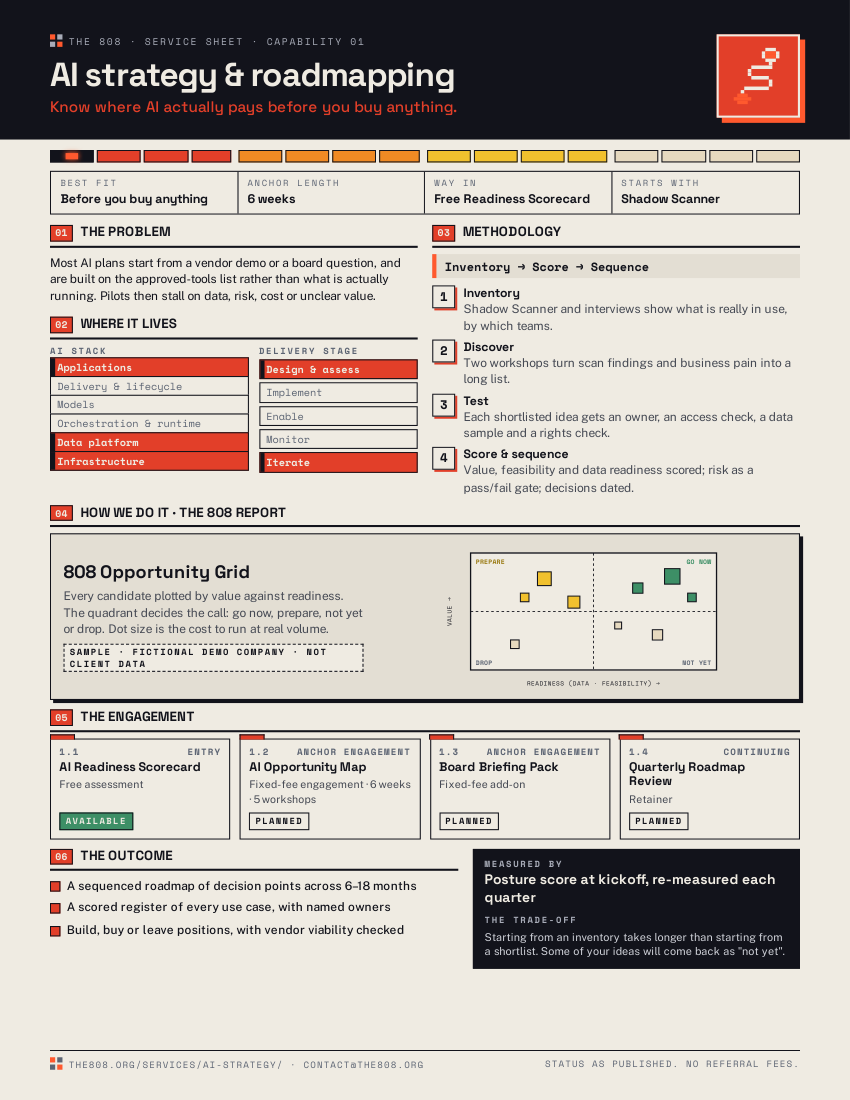
AI strategy & roadmapping
Where AI pays in your business, and where it doesn't yet. We start from what is actually running, score use cases on value and data readiness, then set decision points for the next 6–18 months. Expect to be told to wait on some of them.
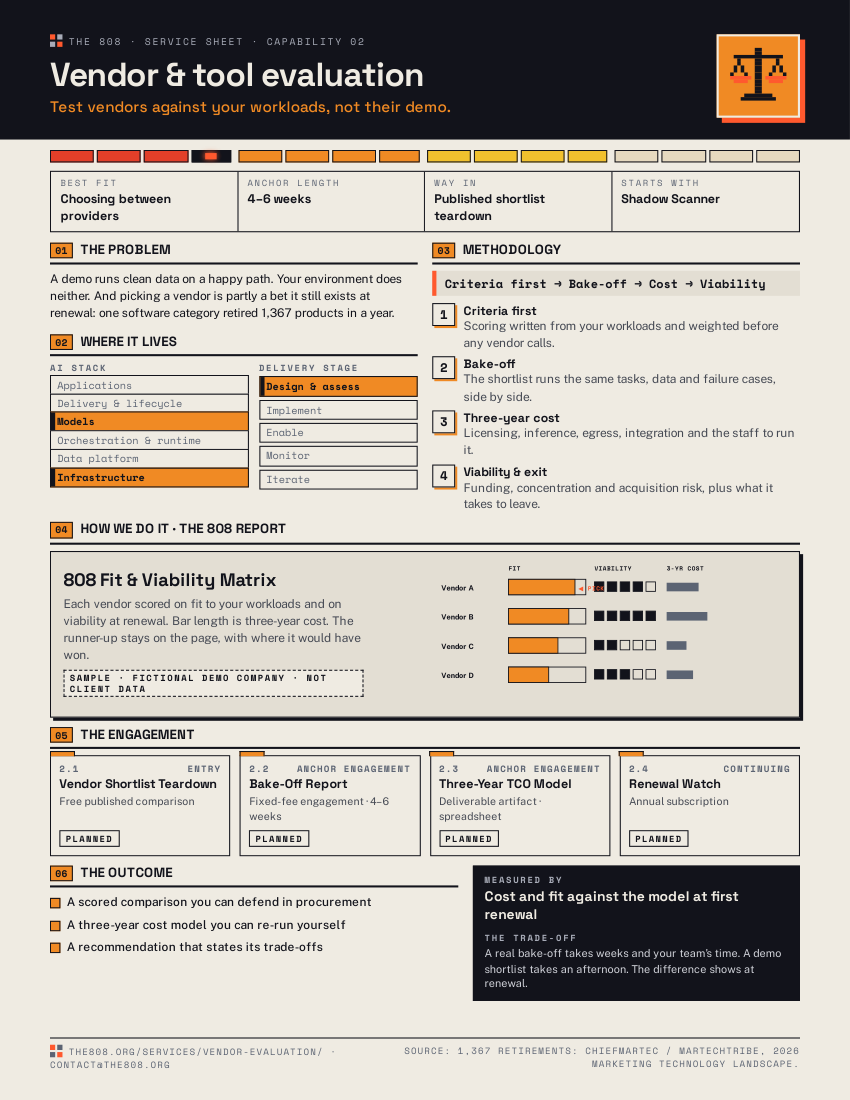
Vendor & tool evaluation
Your shortlist run side by side on your workloads, your data and your failure cases. Criteria are agreed before any vendor calls. Three-year cost and vendor viability are scored next to features, because a retired product is an unplanned migration.
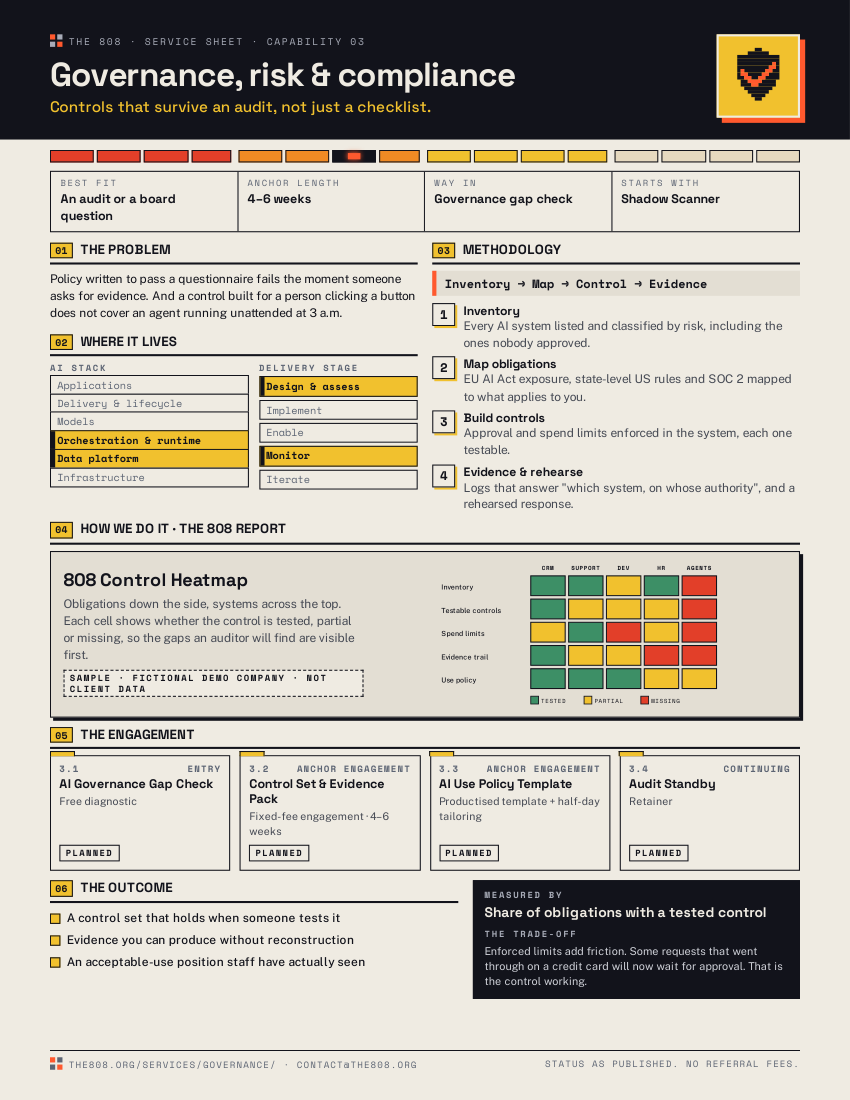
Governance, risk & compliance
Obligations under the EU AI Act, state-level US rules and SOC 2, turned into controls someone can test. Limits enforced in the system, not described in a policy. Evidence that answers an auditor without a reconstruction exercise.
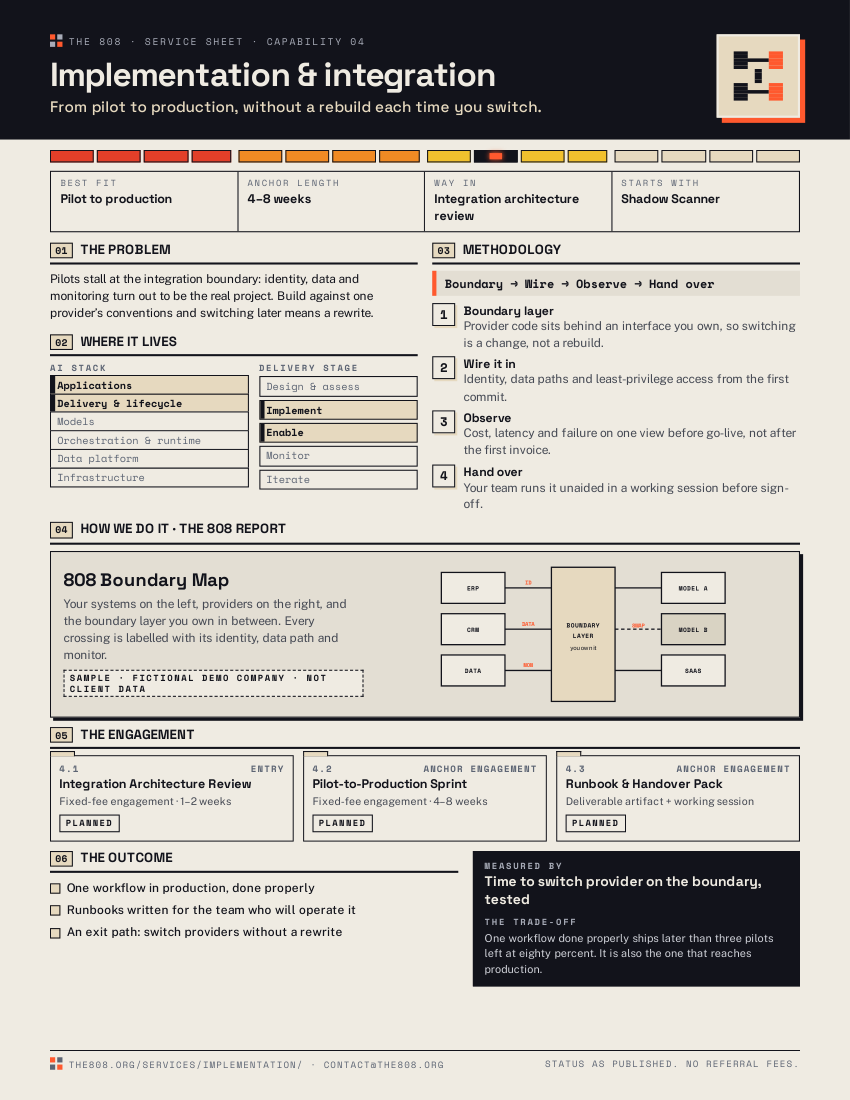
Implementation & integration
Pilots stall at the integration boundary. We build that boundary: identity, data paths and cost monitoring wired in before go-live, with provider code behind an interface so switching is a change, not a rebuild.
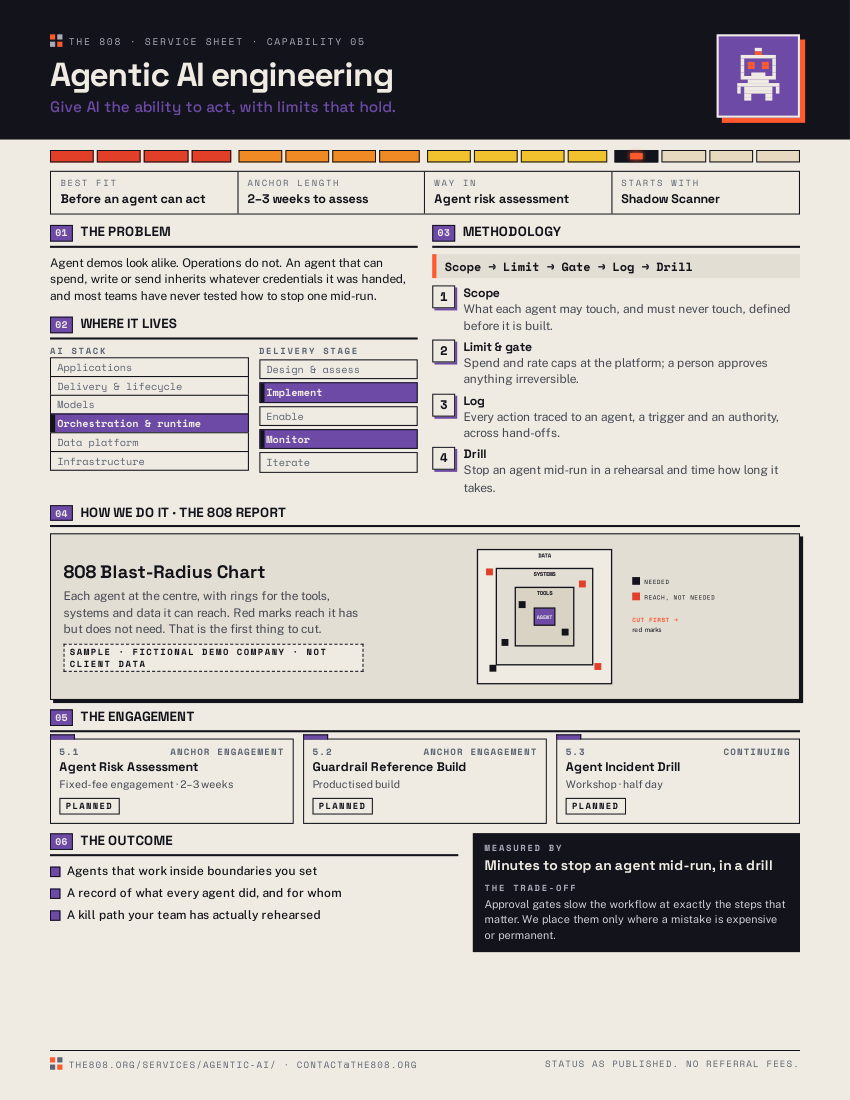
Agentic AI engineering
Agent demos converge. Operations do not. We scope what each agent may touch, enforce spend and rate caps, gate the irreversible steps behind a person, log every action, and test the kill path before go-live.
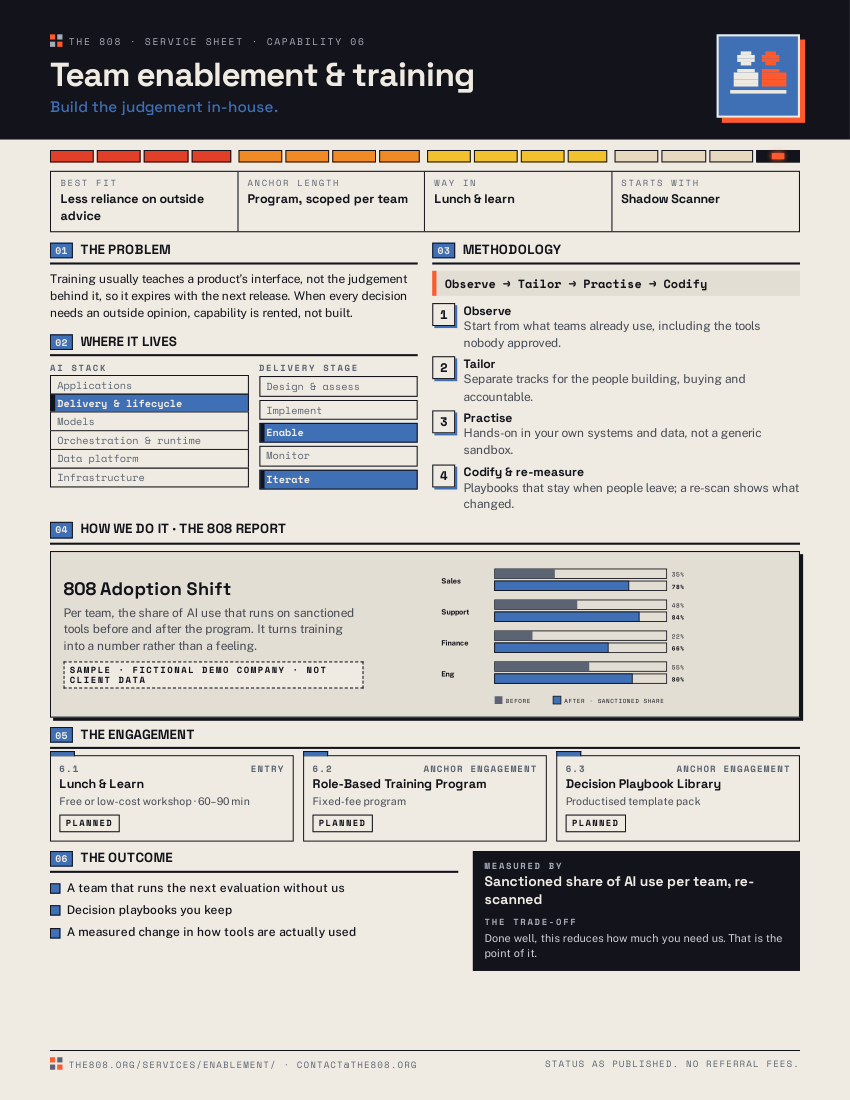
Team enablement & training
Judgement built in-house, on your own systems, so decisions don't depend on whichever vendor was in the room last — or on us. Role-specific sessions and written playbooks that outlast the people who attended.
Assessments & tools
where most engagements startOur tool: the AI Roadmap Builder
free · runs in your browser · no emailThe AI Roadmap Builder is our AI Opportunity Map method, made self-serve. List the AI ideas on the table, score each one, and run it. You get a roadmap report with an 18-month sequence, the conditions each step needs, and a Roadmap Score you can track over time.
The Roadmap Score · 0–100
- VisibilityHow much of the business you have looked at: business areas covered and use cases scored.
- ValueAverage value of the use cases still in play.
- ReadinessAverage feasibility and data readiness of those use cases.
- RiskShare of use cases that pass the risk gate.
0–39 Early40–59 Developing60–79 Ready to sequence80+ Ready to scale
The score updates live as you work and is recorded each time you run the report, so you can see it move quarter to quarter.
What it does
- Starter ideas for seven business areas, or add your own.
- Score value, feasibility and data readiness from 1 to 5, with a plain description of every level.
- A pass/fail risk gate with the reason recorded. A fail can never be "Go now".
- A live Opportunity Grid and live Roadmap Score while you work.
- Four calls: Go now, Prepare, Not yet, Drop. Click any of them to see those use cases.
- Run it for a report: summary, grid, 18-month timeline, decision points, unlock conditions, next steps.
- Print or save as PDF, download as HTML or CSV. Nothing leaves your browser unless you send it.
Who it's for
- CIOs, CTOs and heads of IT asked for an AI plan.
- COOs and business-unit leads with a list of AI requests and no way to rank them.
- Finance leads who need to see value before budget is committed.
- AI programme or transformation leads keeping a portfolio honest.
When it works best
- Before a budget cycle, so spending follows a ranked list.
- After a wave of vendor demos, to separate the useful from the impressive.
- Before an AI Opportunity Map, as the starting inventory.
- Every quarter, re-scored, to track the Roadmap Score.
How to run it well
- Do it in a 60–90 minute session with the people who own each area, not alone.
- Take one business area at a time. Five honest use cases beat twenty guesses.
- Score data readiness on what you can show today, not what is planned.
- When unsure, score lower. Self-scores tend to run high.
How it informs our recommendation
- Send us the report or CSV and the first workshop starts from your list.
- We test your scores against evidence: a Shadow Scanner inventory, data samples and a value range checked with finance.
- Where your score and the evidence disagree, that difference is usually the most useful finding.
- The gaps it ranks tell us which service to start with, so we don't sell you the wrong one.
Services that use it most
How every engagement runs
assess → implement → enable → monitor → iterateWhichever service brought you here, it runs through the same five stages. A roadmap nobody can implement isn't finished. Neither is a tool nobody was taught to run. The cost is that we rarely do a one-off deliverable and walk away.
Design & assess
Inventory what is actually running, name the constraints, and design the plan around them — not around a platform's release calendar.
Implement
Stand up the chosen tools inside your existing systems. Spend limits, approval gates and logging go in first, not after the first incident.
Enable
Your team runs it, on your systems, before sign-off. The playbooks stay when the people who attended move on.
Monitor
Track usage, cost and risk against what was promised. A re-scan shows whether the posture actually moved.
Iterate
Feed the findings back into the plan. Vendors get acquired, models get replaced, prices move. The roadmap should move with them.
Services catalogue
21 engagements & products · 1 liveEvery engagement and product across the six capabilities, and where each one stands today. Each service page also carries a checklist of what good looks like, and which item covers it. Most of this list is planned, and it says so. We would rather show the roadmap than imply a bench we don't have.
All six service sheets (PDF) ↓
| Ref | Engagement / product | Capability | Type | Status |
|---|---|---|---|---|
| 1.1 | AI Readiness Scorecard | AI strategy | Free assessment | ✓ Available |
| 1.2 | AI Opportunity Map | AI strategy | Fixed-fee engagement · 6 weeks · 5 workshops | ◻ Planned |
| 1.3 | Board Briefing Pack | AI strategy | Fixed-fee add-on | ◻ Planned |
| 1.4 | Quarterly Roadmap Review | AI strategy | Retainer | ◻ Planned |
| 2.1 | Vendor Shortlist Teardown | Vendor evaluation | Free published comparison | ◻ Planned |
| 2.2 | Bake-Off Report | Vendor evaluation | Fixed-fee engagement · 4–6 weeks | ◻ Planned |
| 2.3 | Three-Year TCO Model | Vendor evaluation | Deliverable artifact · spreadsheet | ◻ Planned |
| 2.4 | Renewal Watch | Vendor evaluation | Annual subscription | ◻ Planned |
| 3.1 | AI Governance Gap Check | Governance | Free diagnostic | ◻ Planned |
| 3.2 | Control Set & Evidence Pack | Governance | Fixed-fee engagement · 4–6 weeks | ◻ Planned |
| 3.3 | AI Use Policy Template | Governance | Productised template + half-day tailoring | ◻ Planned |
| 3.4 | Audit Standby | Governance | Retainer | ◻ Planned |
| 4.1 | Integration Architecture Review | Implementation | Fixed-fee engagement · 1–2 weeks | ◻ Planned |
| 4.2 | Pilot-to-Production Sprint | Implementation | Fixed-fee engagement · 4–8 weeks | ◻ Planned |
| 4.3 | Runbook & Handover Pack | Implementation | Deliverable artifact + working session | ◻ Planned |
| 5.1 | Agent Risk Assessment | Agentic AI | Fixed-fee engagement · 2–3 weeks | ◻ Planned |
| 5.2 | Guardrail Reference Build | Agentic AI | Productised build | ◻ Planned |
| 5.3 | Agent Incident Drill | Agentic AI | Workshop · half day | ◻ Planned |
| 6.1 | Lunch & Learn | Enablement | Free or low-cost workshop · 60–90 min | ◻ Planned |
| 6.2 | Role-Based Training Program | Enablement | Fixed-fee program | ◻ Planned |
| 6.3 | Decision Playbook Library | Enablement | Productised template pack | ◻ Planned |
Each capability has the same shape. An entry piece that shows we understand the problem. An anchor engagement that does the work. Continuing support that keeps it current.
Tell us what you're running.
A person replies within one business day.