Capability 04
From pilot to production, without a rebuild each time you switch.
Engineering that stands up the tools you chose inside the systems you already run. Identity, data and monitoring go in first. Provider code sits behind an interface you own.
Best fit: pilot to production
Downloads
take it to the meetingService sheets follow one standard across all six capabilities. Engagement status on each sheet is taken from the live catalogue.
The problem
what goes wrongPilots stall at the integration boundary. The model works; the plumbing doesn't. Identity, data pipelines and monitoring turn out to be the real project, and they were scoped as an afterthought.
The second failure is lock-in by accident. Build against one provider's conventions and switching later means rewriting the integration layer. In practice, that means not switching.
The third is meaning. Two systems define "customer" differently, and an agent reading both gives two answers. Shared definitions are a data job, and we flag it as a gap below rather than pretend we cover it.
What we do
four piecesIntegration architecture
A boundary layer between your systems and the vendor. Changing provider becomes an integration change, not a rebuild.
Data and identity wiring
Pipelines and access paths scoped to least privilege from the first commit, not tightened after a review.
Observability from day one
Cost, usage, latency and failure on one view before go-live. Inference cost scales with use, so the bill arrives just as the thing starts working.
Handover that holds
Runbooks written for the team who will operate it. They run it unaided before we sign off.
Tools & resources
how this service uses themDownloads for this service are above. All free tools run in your browser and need no email.
What good looks like
5 of 7 coveredWhat buyers are increasingly measured against here, taken from the frameworks doing the measuring. Each line names the engagement that covers it. Where nothing does yet, the row says so.
| Capability | What done properly looks like | Covered by |
|---|---|---|
| A boundary layer between you and the vendorPortability practice | Provider-specific code sits behind an interface, so switching is an integration change rather than a rebuild. | 4.1 Integration Architecture Review |
| Least privilege from the first commitZero-trust practice | Access is scoped at build time, not tightened after a review finds it wide open. | 4.2 Pilot-to-Production Sprint |
| Cost and reliability observability on day oneFinOps practice | Spend, latency and failure rates are instrumented before go-live and watched together, not added after the first surprise invoice. | 4.2 Pilot-to-Production Sprint |
| One workflow taken properly to productionDelivery practice | Scope is a single workflow with a defined done, rather than three pilots left at eighty percent. | 4.2 Pilot-to-Production Sprint |
| Shared definitions for the terms agents useData management practice | Core business terms are defined once and used by every system an agent reads, so two agents cannot give two answers to one question. | Not yet offered |
| Operational handover that is testedITIL · Service transition | The receiving team runs it unaided in a working session before sign-off. | 4.3 Runbook & Handover Pack |
| Rollback and removal defined before deploymentChange management practice | The path back — switch it off, undo its changes, take the data out — is written and rehearsed, not improvised during an incident. | Not yet offered |
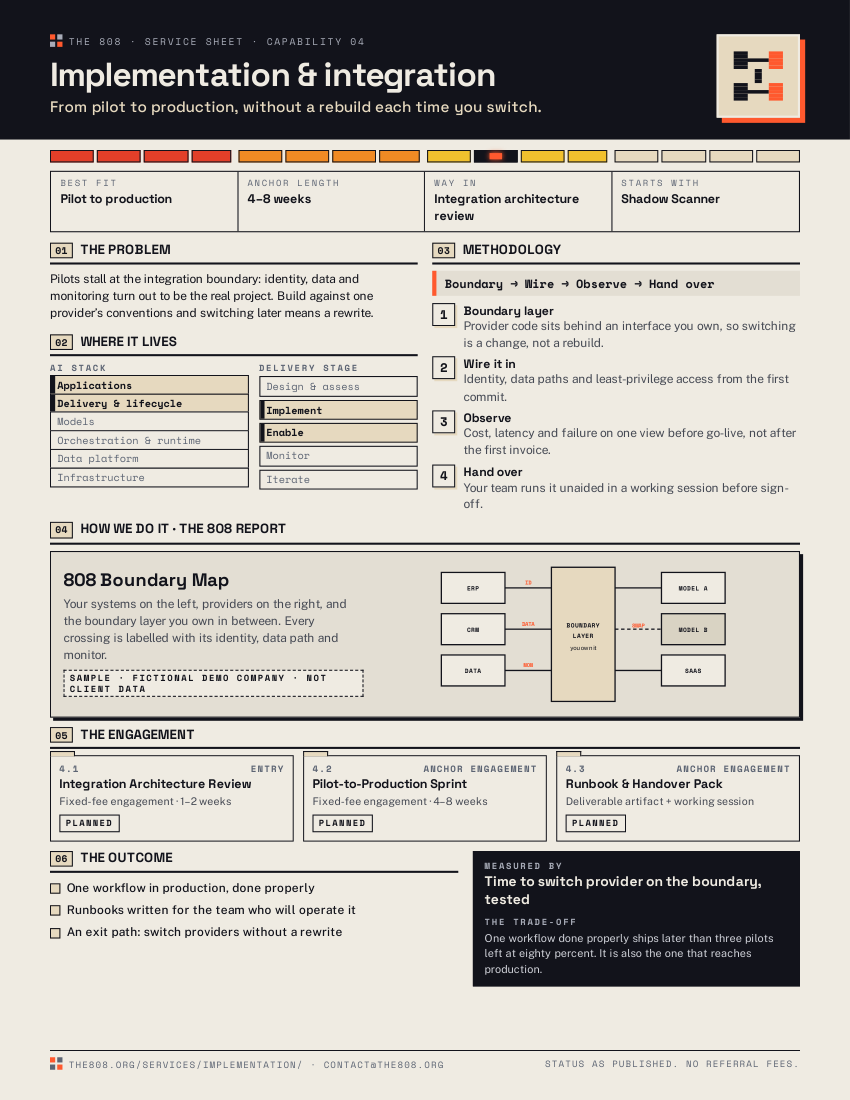
Sample report: 808 Boundary Map
808 demo datasetFictional demo company · sample data, not a client
Lakeshore Example Co.
A fictional 1,200-person distributor we use to show what our reports look like. Every number below is invented for the demo.
- 3 systems wired through one boundary layer: ERP, CRM, data
- 3 crossings, each with identity, data path and monitor
- Model provider swapped in a test: config change, no rewrite
- One workflow live: order-exception triage
Engagements & products
status shownThe deliverables behind this capability. We publish what is live and what is still being built rather than implying a bench we don't have.
-
4.1 Entry Planned
Integration Architecture Review
Fixed-fee engagement · 1–2 weeks
How your chosen tool will meet the estate you already run — identity, data pipelines, monitoring — and where lock-in would quietly build up. The output is a boundary-layer design, so providers can change without a rebuild.
Shadow Scanner The scan maps what the new tool has to coexist with, including the things nobody documented.
-
4.2 Anchor engagement Planned
Pilot-to-Production Sprint
Fixed-fee engagement · 4–8 weeks
We take one stalled pilot into production: integration layer, least-privilege access, and observability on cost, usage, latency and failure from day one. One workflow, done properly, rather than three left half-finished.
Shadow Scanner Findings are paired with migration destinations and sequenced by exposure rather than by whichever is cheapest.
-
4.3 Anchor engagement Planned
Runbook & Handover Pack
Deliverable artifact + working session
Documentation written for the team who will operate the thing, not the people who built it. Then a session where they prove they can run it without us. That is what makes "we don't create dependency" checkable.
Shadow Scanner A closing re-scan evidences what actually moved, so handover is a fact rather than an assertion.
Status is kept in one place and shown as it stands. See the full catalogue across all six capabilities.
Further reading
frameworks · research · our work, on this topic- ReferenceThe enterprise AI stack: where integration failures show upOur layer-by-layer map of where AI projects break in production.The 808 →
- StandardModel Context Protocol specificationThe open protocol many AI tools now use to connect to business systems.Model Context Protocol project ↗
- ResearchIdentity management for agentic AIHow sign-in and permissions should work when software, not people, makes the request.OpenID Foundation ↗
- FrameworkWell-Architected Framework: AI and ML perspectiveA vendor’s checklist for running AI workloads reliably in production.Google Cloud ↗
How Shadow Scanner helps
platform intelligence & risk telemetryA finding needs a destination. Shadow Scanner pairs each detected tool with the sanctioned platform it should move into. That turns an assessment into an ordered piece of work.
What you walk away with
the outcomeA production deployment your own team can operate, extend and, if it comes to it, migrate off — without the original engineers in the room.
The trade-off. One workflow done properly ships later than three pilots left at eighty percent. It is also the only one of the four that reaches production.
Tell us what you're running.
A person replies within one business day.