Capability 06
Build the judgement in-house.
Sessions on your own systems and playbooks you keep, so day-to-day decisions don't depend on whichever vendor was in the room last. Or on us.
Best fit: less reliance on outside advice
Downloads
take it to the meetingService sheets follow one standard across all six capabilities. Engagement status on each sheet is taken from the live catalogue.
The problem
what goes wrongTraining usually solves the wrong problem. Teams learn a product's interface, not the judgement behind it. The knowledge expires with the next release or the next vendor.
The dependency is the real cost. When every meaningful decision needs an outside opinion, the organisation isn't building capability. It is renting it.
What we do
four piecesWorking sessions
Hands-on with your own systems and data, not a generic sandbox.
Decision playbooks
How to evaluate a tool, scope a pilot and know when to walk away. Written down, reusable.
Role-specific depth
Different material for the people building, the people buying, and the people accountable.
Documentation that outlasts tenure
The knowledge stays when the person who attended moves on.
Tools & resources
how this service uses themDownloads for this service are above. All free tools run in your browser and need no email.
What good looks like
6 of 6 coveredWhat buyers are increasingly measured against here, taken from the frameworks doing the measuring. Each line names the engagement that covers it. Where nothing does yet, the row says so.
| Capability | What done properly looks like | Covered by |
|---|---|---|
| Training aimed at real behaviourAdoption practice | Material is built from what teams already use, including the unsanctioned tools, rather than a generic syllabus. | 6.2 Role-Based Training Program |
| Role-appropriate depthISO/IEC 42001 · Competence | Builders, buyers and accountable owners get different material, because they make different decisions. | 6.2 Role-Based Training Program |
| Hands-on with your own systemsAdoption practice | People practise in the environment they actually work in, so what they learn survives contact with it. | 6.2 Role-Based Training Program |
| Written playbooks that outlast attendanceKnowledge management practice | Decisions are documented as repeatable procedures, so knowledge does not leave with the person who attended. | 6.3 Decision Playbook Library |
| A measurable change after the sessionNIST AI RMF · Measure | Behaviour is re-measured afterwards, so enablement produces a number rather than a feeling. | 6.2 Role-Based Training Program |
| A low-friction way in for new teamsAdoption practice | There is a short, cheap first session that does not require a budget cycle to approve. | 6.1 Lunch & Learn |
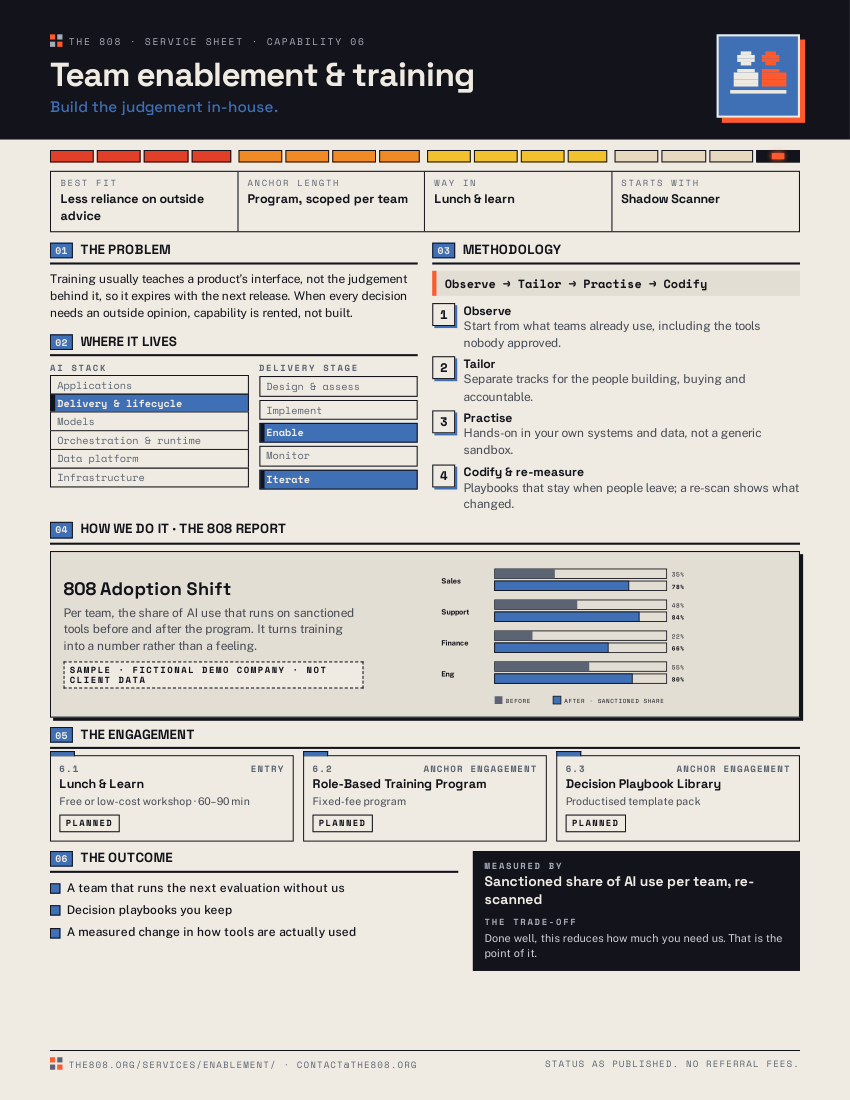
Sample report: 808 Adoption Shift
808 demo datasetFictional demo company · sample data, not a client
Lakeshore Example Co.
A fictional 1,200-person distributor we use to show what our reports look like. Every number below is invented for the demo.
- 4 teams trained over one program
- Sanctioned share of AI use rose in every team
- Largest shift: Finance, 22% → 66%
- Playbooks adopted: tool evaluation, pilot scoping
Engagements & products
status shownThe deliverables behind this capability. We publish what is live and what is still being built rather than implying a bench we don't have.
-
6.1 Entry Planned
Lunch & Learn
Free or low-cost workshop · 60–90 min
One topic, one session, your team: evaluating a tool, scoping a pilot, or where AI genuinely helps this particular group. Low friction by design, and the questions asked in the room tell us what you actually need.
-
6.2 Anchor engagement Planned
Role-Based Training Program
Fixed-fee program
Separate tracks for the people building, buying and accountable. Run on your own systems and data, not a generic sandbox, so what people learn survives contact with the real environment.
Shadow Scanner Per-team usage shows who has already adopted something unsanctioned, so the material targets real behaviour. A re-scan afterwards shows whether it moved.
-
6.3 Anchor engagement Planned
Decision Playbook Library
Productised template pack
Written playbooks you keep: how to evaluate a tool, how to scope a pilot, how to judge when to walk away, and how to escalate an incident. The deliverable that survives the person who attended the session leaving.
Status is kept in one place and shown as it stands. See the full catalogue across all six capabilities.
Further reading
frameworks · research · our work, on this topic- GuideAI literacy: questions and answers (EU AI Act, Article 4)What the EU’s AI-literacy duty asks of employers, in plain language.European Commission ↗
- ReportAI at Work: Momentum Builds, but Gaps RemainSurvey of how employees use AI and where training falls short.Boston Consulting Group ↗
- ResearchTrust, attitudes and use of AI: a global study 2025Global data on how much people trust AI and how they use it at work.KPMG & University of Melbourne ↗
- BriefingThe Weekly Brief: what changed in enterprise AI this weekOur ranked weekly reading list for teams adopting AI.The 808 →
How Shadow Scanner helps
platform intelligence & risk telemetryTraining lands when it starts from what people already do. Shadow Scanner shows which teams use which applications, so sessions target real behaviour instead of a generic syllabus. A re-scan afterwards shows whether it moved.
What you walk away with
the outcomeA team that can run the next evaluation without us, and the written material to bring new people to the same standard.
The trade-off. Done well, this reduces how much you need us. That is the point of it.
Tell us what you're running.
A person replies within one business day.